Our world is full of wonderful new races that players will be able to enjoy. You’ve met the Mastaari, deeply spiritual elephantine sages and scholars who have adapted to dangers through tribal kinship. The Stormhall Dwarves who, despite their dark history, have an insatiable thirst to build a brighter future through futuristic engineering and studying the stories of past and present. The humans of Anterose, sons and daughters of a fallen empire who kept the faith of Solaris and girded their society from anarchism. The elves of Iretheia whose exceedingly long lives aided them in their absolute mastery of everything and desire for permanence.
Four more playable races remain to be revealed, bound by the wounds of their shared past. Today, before we meet them, we turn to a nation whose deeds shaped the course of history, leaving a legacy that still echoes throughout the world.
THE FALLING STARS
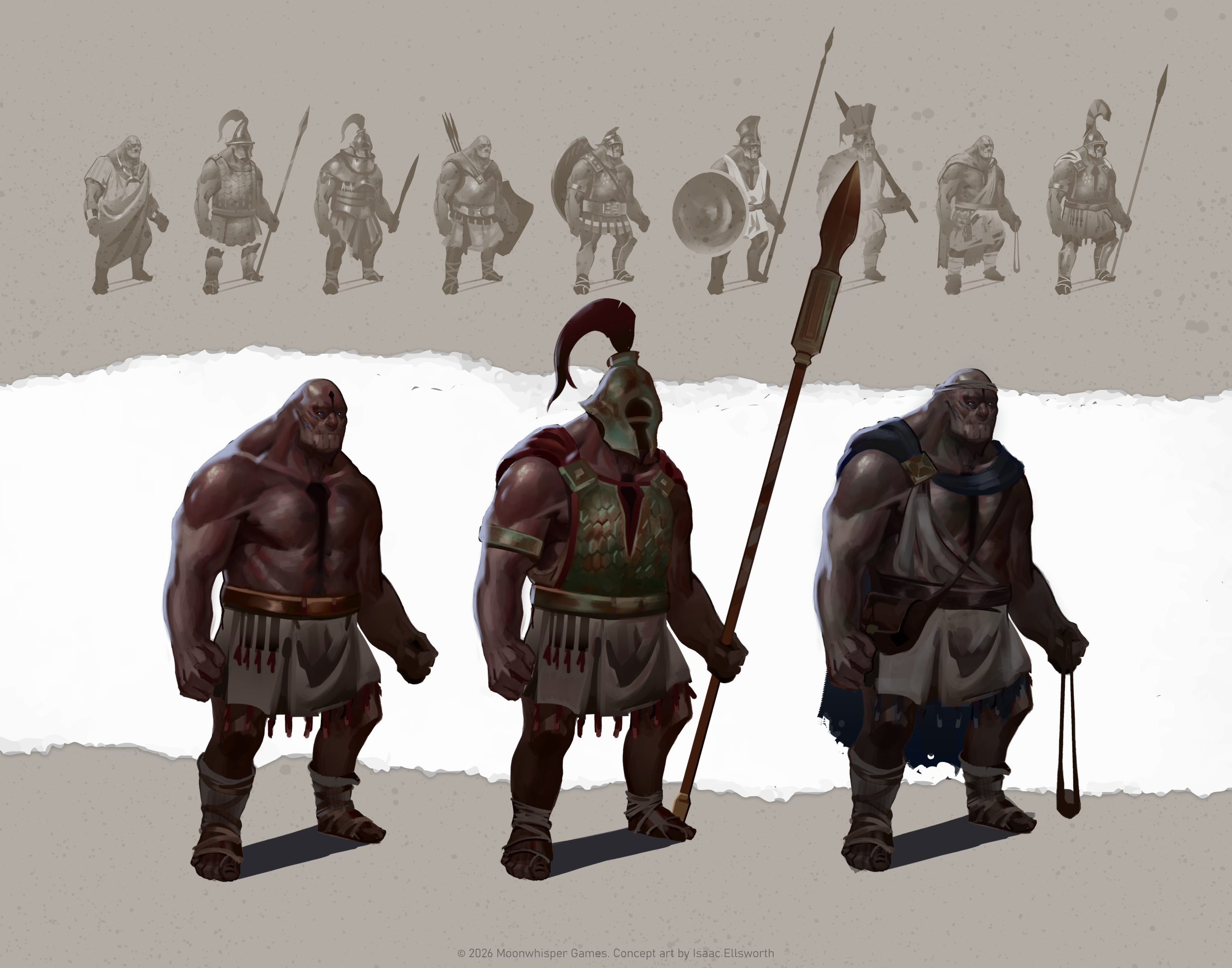
Legends claim that the Kolossus were born the day the sky rained fire. Stars had fallen to the world, binding with the granite and stone, and from that broken earth they arose, the first giants. Mountainous humanoids, chiseled from rock, with grit like crushed diamonds. They stood twice as tall as any man, shoulders as broad as mountain ridges, and walked with a thunderous step that could almost knock a dwarf off their feet. In historical texts and from any elf who’d met them, they were known as the mightiest creatures to ever roam the world.
Ancient songs tell that the Kolossus were born so far apart from their kin, that they would spend their entire first age journeying to find one another. True or not, for most of their history the Kolossus wandered nomadically. The different tribes would follow whoever proved themselves most worthy from one camp to the next.
Strength was no mere trait of the Kolossus, it was their currency. In their society, physical power opened every door both literally and figuratively. Glory, standing, respect, even the throne itself could only be paid for with raw brutal tenacity. The Kolossus bowed only to the mightiest among them, and to those who had earned a name laden with renown.
THE THREE CITIES OF THE WESTERN COAST
It would be a fateful encounter with the elves that changed the Kolossus forever after. Tales tell of an elven visitor who challenged a Kolossus to a test of strength. No Kolossus could resist such a challenge, though the sight of the slender figure before them was met with amusement rather than concern. Indulging the seemingly unserious request, the leader of the tribe stepped forward and extended his arm downward to the elf as was the custom. The elf extended his own hand and as the giant began exerting pressure downward, slightly worried he might kill the elf, he was surprised to find himself flipping through the air and landing upon his back with a tremendous thud. The entire tribe was shocked, but the elf merely bowed in thanks for the opportunity to test his skill and asked if they would be open to trade and cultural exchange with his people. Having already earned their respect, the Kolossus could not refuse the offer.
Trade brought goods, and with the goods came customs, myths, and the habit of staying in one place long enough to build something lasting. A new challenge arose for the Kolossus. One that required their wit rather than their strength for once. To the surprise of their newfound elven friends, they managed to rise above all expectations.
As the nomadic tribes gathered into one large camp for trade, the camps grew into towns, towns into cities, and the greatest of them into city-states. Three major cities formed and marked their greatest and mightiest civilizations along the western coast: Argon, Pyrakos, and Torinth.
THE ALLIANCE OF ARGON & ATREA
Golian of Argon did not inherit his crown. He had out-built, out-argued, out-fought and out-lasted every rival until no one in Argon could contest his claim to power. His aspirations were drawn from the majesty of the elven city of Atrea. There he saw what the Kolossus could achieve, and demanded nothing less than to grow stronger than even the elves.
Argon’s people, however, were humble; too humble for his taste, and their lack of thirst for the new became problematic for his goals. The king, who had given his city everything it needs, and everything he knows, became restless for something no one in his court could offer. Golian would spend years searching ancient ruins and chasing rumors of elven relics that always seemed to slip through his grasp.
Golian’s adventures ultimately led him into a deep cavern, where the wyrm Laggnothar lay at rest. Laggnothar had settled in for a nice nap that month, and the stomping of the Kolossus was most unwelcome. The wyrm awoke, tearing the armor from Golian’s body and draining the strength from his limbs as it sought to crush the life out of him. Were the Kolossus any less driven, those would be the last words spoken about Golian of Argon. Yet he clung to life and in his hour of need, the treasure which he sought came to his aid. Though it was not in the form of any artifact he had been chasing. Instead, it was the elven heir to the Kingdom he had been inspired by.
Prince Asterios of Atrea wasted no time in aiding the wounded Kolossus. His grace in combat left Golian marveling at the sight. Despite his own great strength he was humbled by the elf's presence. They formed a bond in blood as they fought Laggnothar together, ultimately wounding the wyrm enough to force it to retreat. Golian was grateful and grew curious as the two made the long climb out of the caverns side by side. The Prince explained that he had been checking in on Laggnothar’s movements to ensure the wyrm would not return to hunt in their lands, but was shocked to find it desperately trying and failing to eat a Kolossus. By the time they reached daylight they had formed a friendship that would last both their lives.
The Kolossus of Argon and the Elves of Atrea would henceforth be bound to each other in service.
THE ATREAN WAR
Almost half a century later, the sons of Golian wore crowns of their own.
Atrag, the elder, ruled Pyrakos. He was the spitting image of his father poured into harder stone: slow to start a war, relentless once he had.
Goligan, the younger, ruled Argon. He was quick to laugh, quicker to anger, and devoted to his brother above all else.
Both had sworn to uphold their father's bond with Atrea, so when the Iretheian Coalition declared war against their allies in Atrea, neither brother hesitated. Only the city of Torinth refused to answer the call.
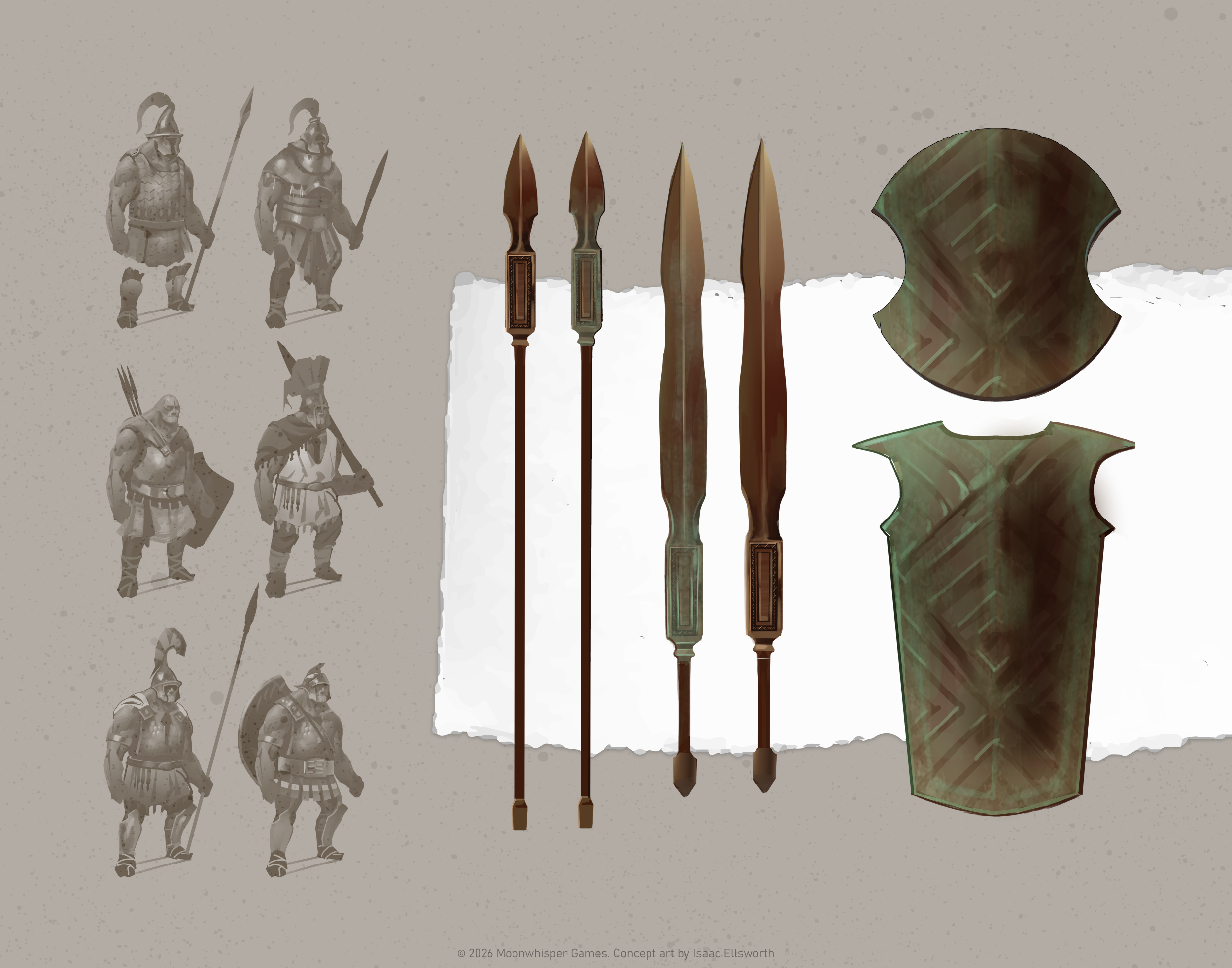
In besieged Atrea the courage of the Kolossus awed even the elven soldiers, who were themselves forged to be arrows in the quivers of their Gods. The feel of battle rekindled a fire that had smoldered in them since their making, and united, the two peoples broke the Coalition’s first advance into scattered bands of runaways.
Atrag, the King of Pyrakos stood steady in front of the gates. Tired but ready to fight to the bitter end. Sadly, it would be Archael, the Incarnate of Heroism himself, that would step forth next from the Coalition’s forces. By steel and spark they clashed, weapons stained with blood and dripping with sweat. Atrag and Archael fought in fevered flurried bouts between longer sessions of swatting away lesser opponents. Many fell in battle until the bodies formed a makeshift arena around the two. In a final bout that shook the city walls, not even the great King of Pyrakos could summon the strength necessary to conquer that which embodied heroism itself. Atrag fell as Archael moved deeper into Atrea to find his next opponent.
As the gates swung wide and the enemy swarmed in, it was the giants of chiseled stone who stood tall in the breach, leaning into the combat to support their weight as they were too stubborn to fall. Goligan was saddled with the grief of his brother’s death as Archael approached, and it formed a pit within his heart that demanded revenge. The duel passed into song before the dust had settled: Goligan the King of Argon against a living Incarnate. When the fight ended, legends were born.
The siege claimed the lives of two Kings and around their deaths the Kolossus wove their greatest ballad. It tells of their final duels beneath the walls, Kings against thousands of soldiers and the living Incarnate, and of Archael falling at last by Goligan's hand. The ballad claims Goligan only allowed death to take him once his vengeance for his brother’s death was complete. Yet despite their valor, Atrea still fell to The Coalition.
The handful of Kolossus that remained marched back to their lands in defeat, and the consequences of the war soon followed them home. The Coalition laid waste to Argon, an act the Kolossus believe was retribution for slaying the Incarnate of Heroism. The elves, however, maintain that the Incarnate did not fall that day. Pyrakos received no siege. Most of its warriors already lay beneath the walls of Atrea, and what remained was a city of mourners behind walls built for giants. The Coalition saw nothing there worth the lives it would cost to breach them: the lengthy and prolonged battle to destroy Argon had already bled them more than enough. Elven lives had been spent, and the toll for destroying yet another Kolossus city was deemed far too costly.
WHAT VENGEANCE LEFT
In the aftermath of Argon's loss, the remaining Kolossus would turn on one another, a callback to times of old where strength determined the future. Wars between their people raged for centuries, which brought ruin to the still-mourning city. When there was no more blood to be shed, only Pyrakos remained. The last vestige of the height of the Kolossus, left as a reminder to the rest of the world. While Elves are tolerated in Pyrakos, the scars of the Atrean War have never faded.
Golian became a symbol to his people, the very example of what a Kolossus may be. Many have claimed to be his heir, or claimed to be him from beyond the veil of death. Yet none have demonstrated his strength or drive to build as he once did.
WHAT WAR COULD NOT BREAK
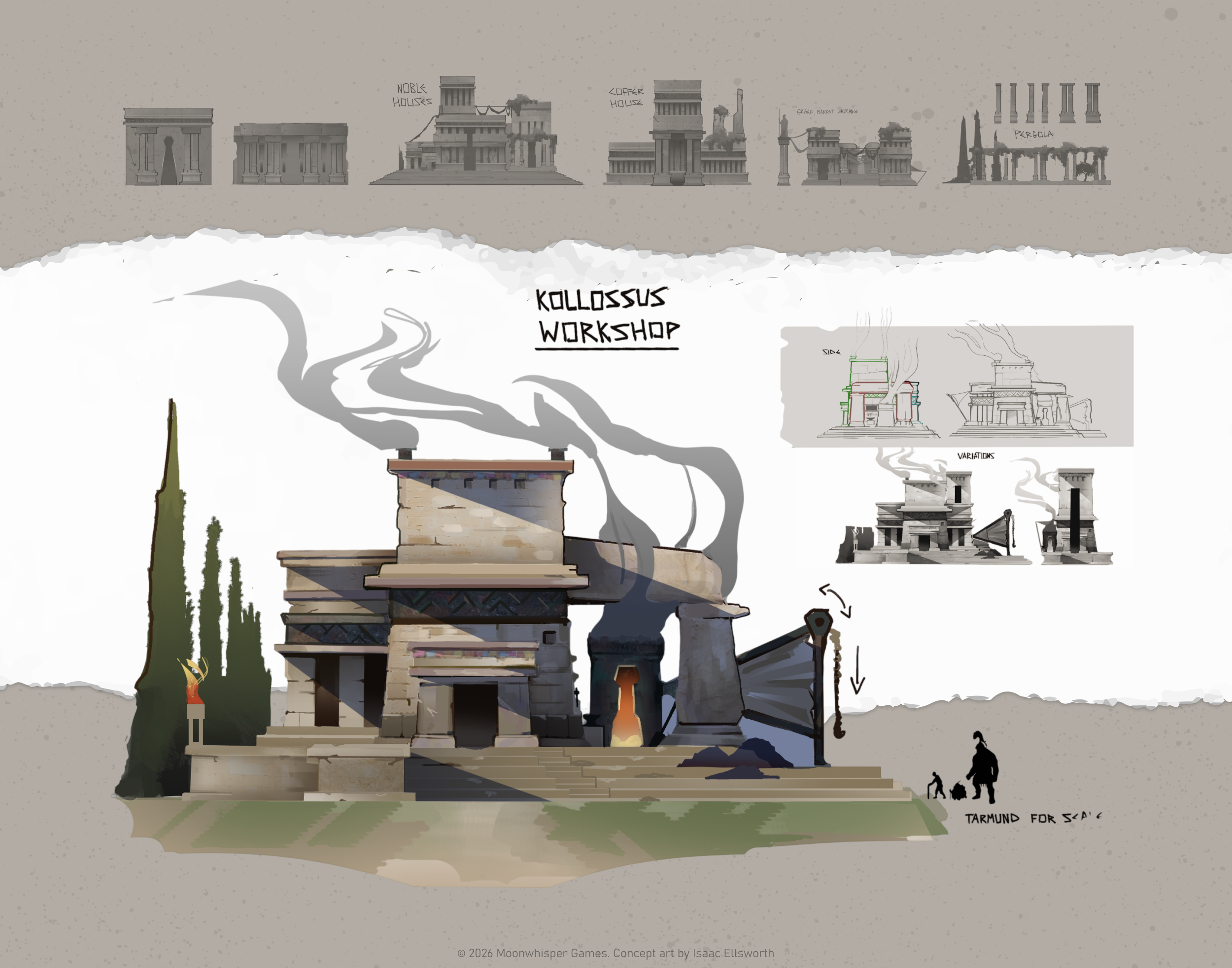
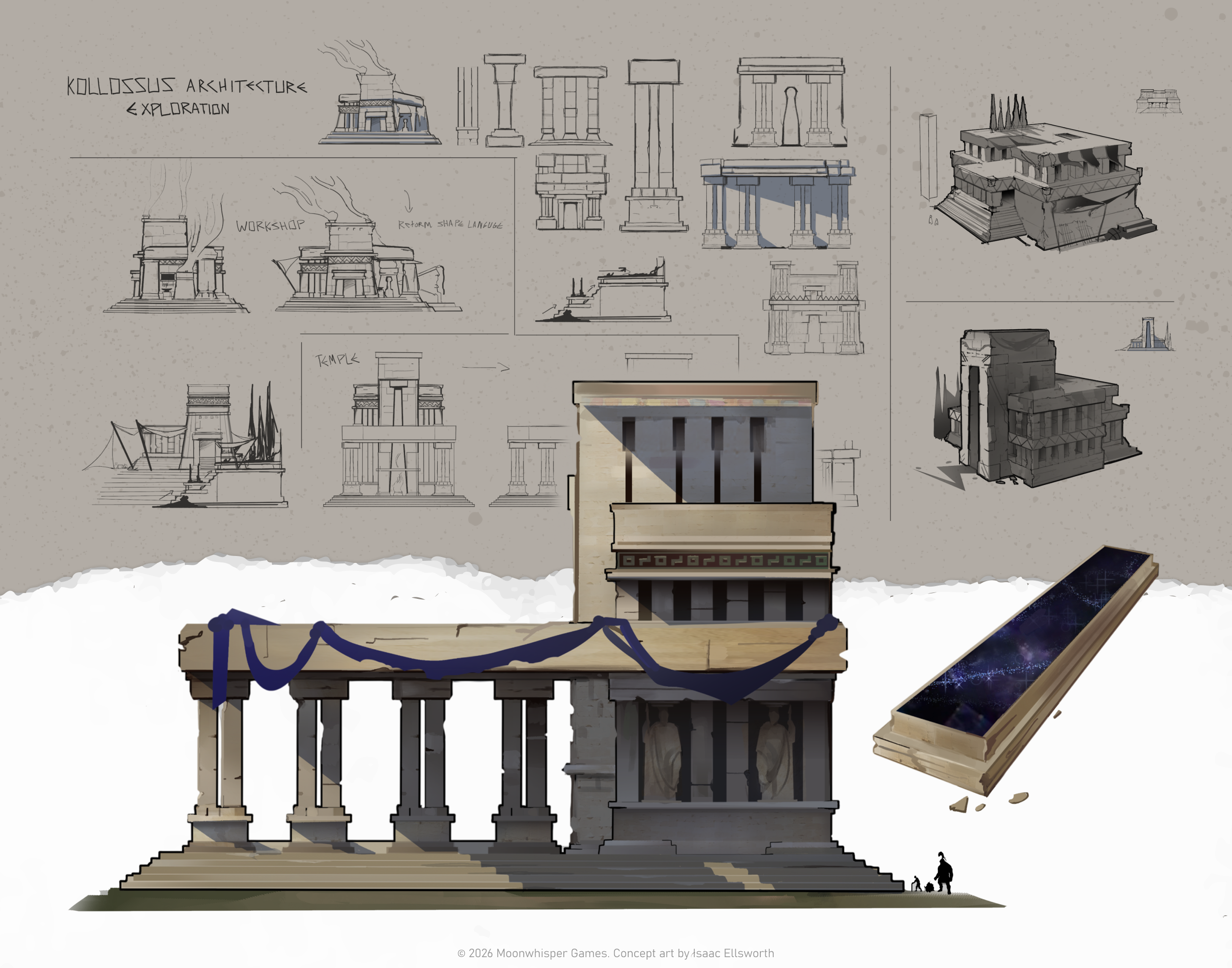
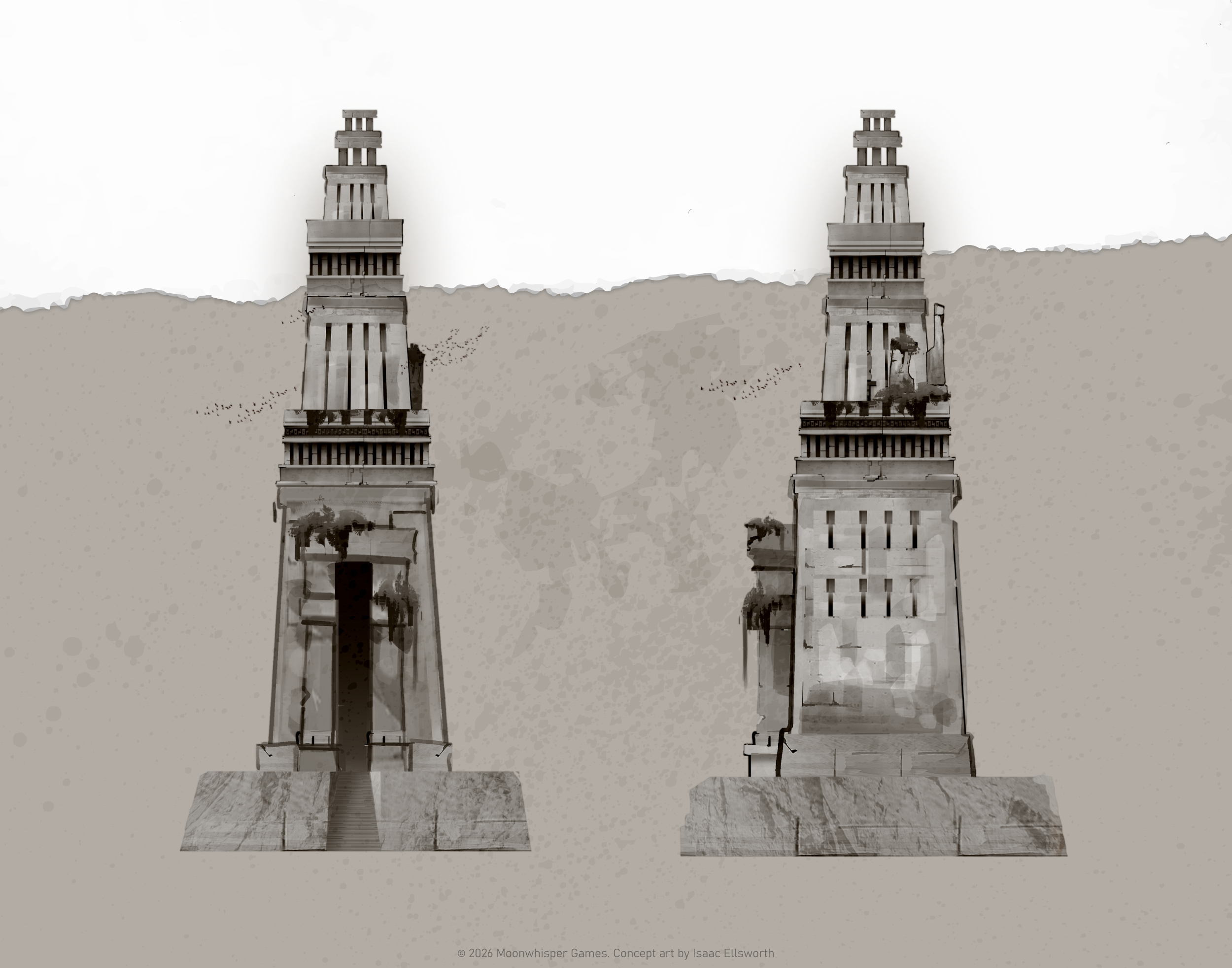
The settlements of the Kolossus carry their devotion to strength in stone. A Kolossus mason did not question the beauty of the halls they built. They made certain that the walls would outlast kings, even their own. Heavy terraces, stairways cut for longer strides, gates built for giants: cities made to stand for ages, and to be seen standing. Though Argon as a city had been destroyed, testament to their building’s strength still stood the test of time. Much so with the mostly empty halls of Pyrakos, though no siege occurred there, the Kolossus who remained never quite recovered. Torinth too was built to last the ages and was untouched by battle.
Yet an uncertain fate befell the city of Torinth. In his vanity, their King welcomed a bold prophet surrounded by shadows. The promise of glory did not outweigh the cost of his people's souls, but in the bargain all was lost. Ruins of the city can still be found in the desert, buried beneath the dunes, a memorial to ill choices. Alas, a story for another day.
UNTIL THE NEXT JOURNEY
The Kolossus sing that Goligan of Argon struck down Archael beneath the walls of Atrea. Some elves maintain that the Incarnate did not fall that way.
Pyrakos still stands as an ever mourning city of the fallen, and the ruins of Torinth lie buried beneath the desert dunes. But that is a story for another day.
So, who do you believe? Come talk it over on Discord and tell us which side you're on!