Another chapter of our world begins with a chosen one, who was never meant to return.
Every winter, the mountain people of Ibera sent a young woman into the forest to die.
This was not considered cruelty, but an offering to the venerated spirits. The Mother Deer held the sun between her antlers, and if she was not given something precious, she might simply decline to bring it back. Nobody had ever tested this theory, on the grounds that the results would be difficult to argue with.
So each year an unwed maiden was chosen, and on the day of the Winter Solstice, she walked into the Spirit Forest, carrying the offerings each tribe provided to the Mother Deer's abode, so that she might join the spirit's life-giving journey. For the tribes, it was the greatest honor imaginable. Yet to the maidens, there was nothing that they feared more.
Then one winter, shortly after the solstice, a strange light rose over the trees.
And the sacrifice walked back out.
Her name was Zolveig. Her red hair had turned to gold, her eyes glowed with an unsettling light, and in her arms she carried the body of the girl who had gone into the forest the year before. Despite the bitter cold, the snow melted beneath her feet.
Shocked by her new appearance, the villagers were uncertain what was standing before them. The druids immediately celebrated this as the spirit's direct intervention, a blessing by the Mother Deer herself, and a sign of a new age.
Zolveig, however, knew the truth.
THE FIRST LIGHT OF ANTEROSE
Zolveig told her village that she was Solaris. Not a messenger of the sun. Not its priestess. The Sun itself, given human form. The ancient rituals were false, she declared. No more daughters would be sent into the forest to die.
The druids called this heresy. They had guarded their sacred order for ages and no sudden intervention by whatever blasphemous being had taken hold of their sacrifice would change that.
Yet there were those who thought differently.
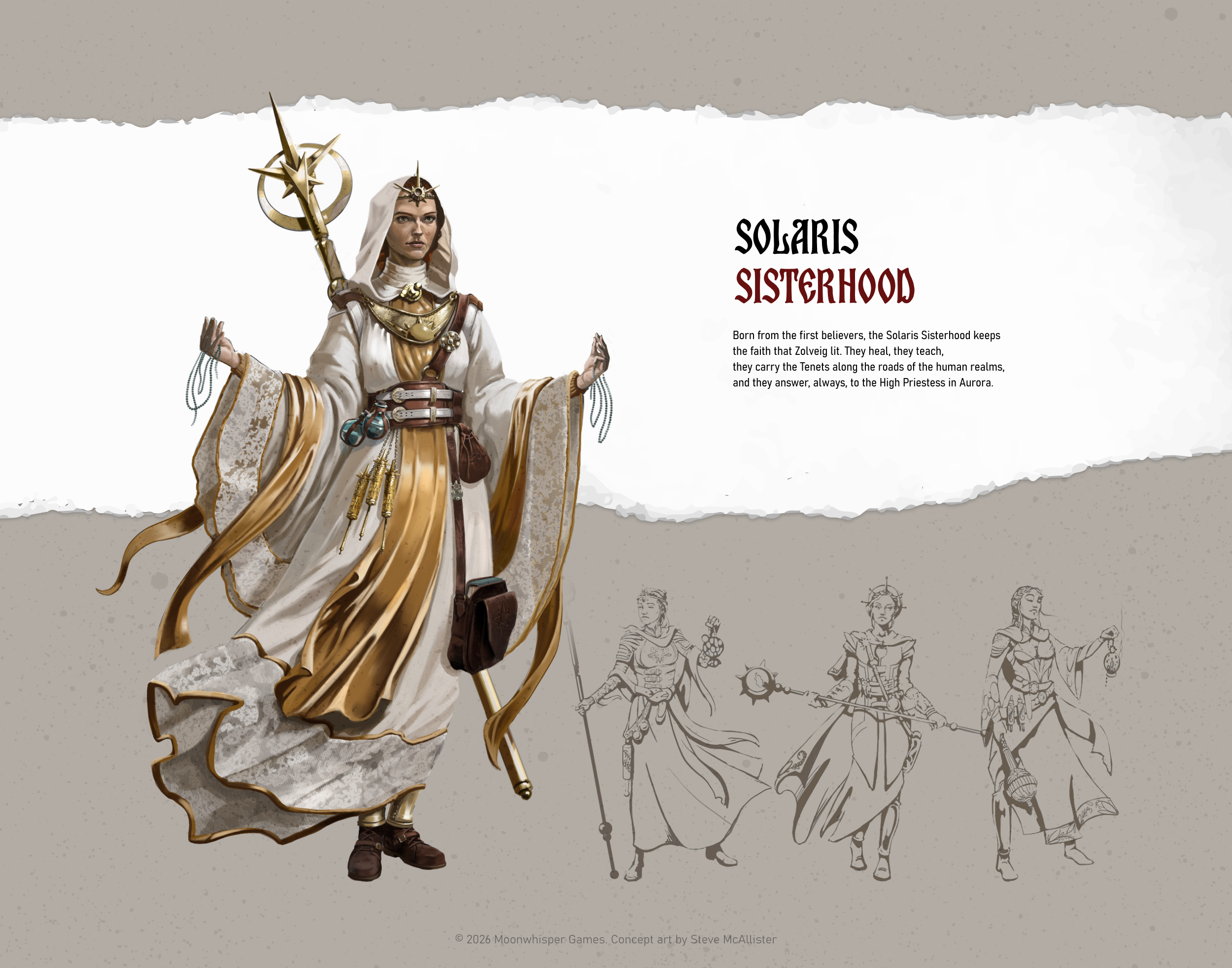
The first to believe her were the mothers. They had carried their grievance and sorrow in silence for generations. Zolveig did not ask them to believe. She only said aloud what they had never dared to, and the old faith lost them in a single winter. So when the figures of old tried to harm the one who brought them truth, they were there to defend her, by all means necessary.
Burning with the righteous fire of her cause, her followers converted the scattered tribes of Ibera, one by one. Zolveig led them out of the mountains and south toward the valley below. Her visions guided them through passes that had killed better prepared travelers, and when they came down out of the snow, they found golden fields waiting.
Where the old faith had asked what could be given up, the new one asked what could be built. And it came carrying answers to questions that had never been asked aloud.
This is how people who buried their daughters in the snow came to light the way for all of humanity. It is also the story of Anterose, the Holy Lands, and the golden city of Aurora that stands at the edge of the world's most beautiful waterfall...
HUMANS OF ANTEROSE (PLAYABLE RACE)
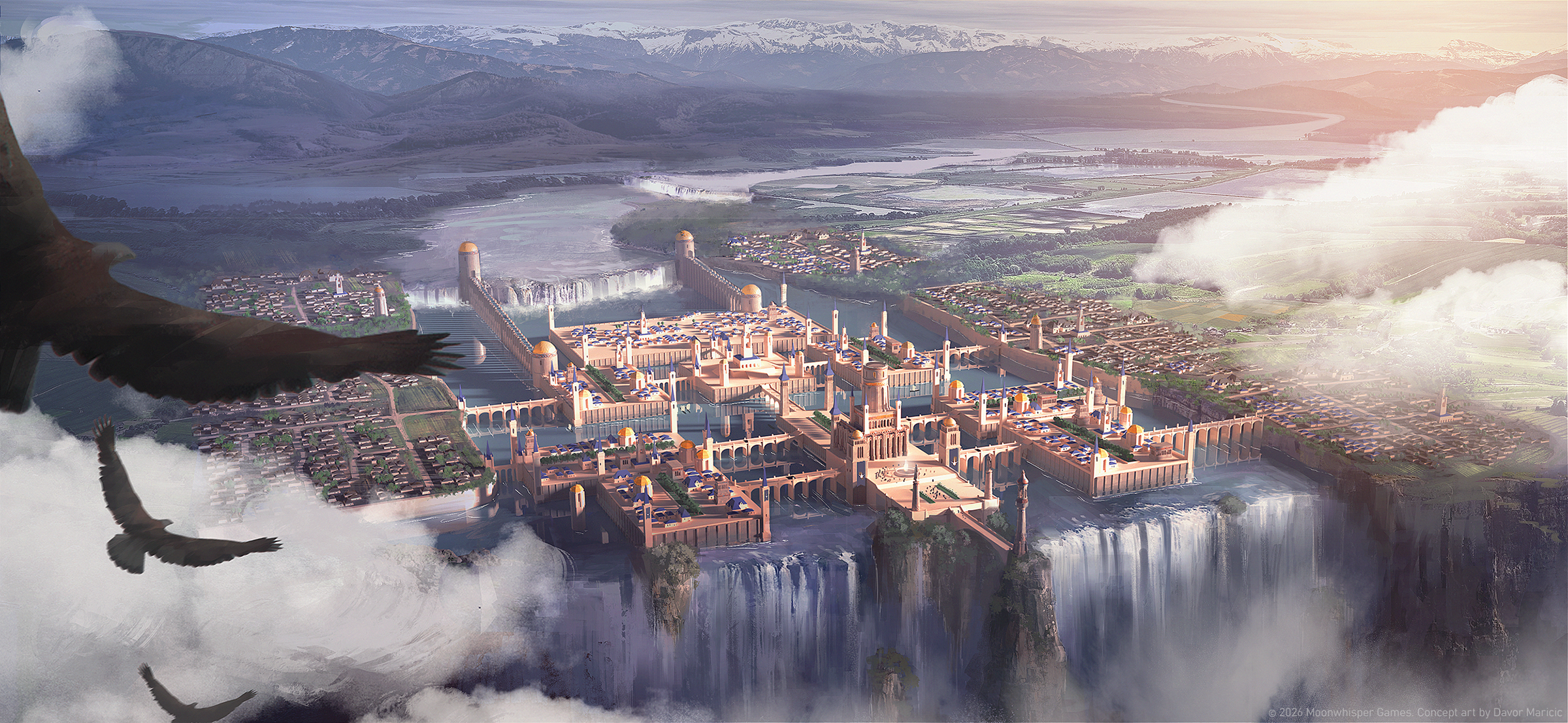
Anterose sits at the northwestern edge of the continent, set between the frozen lands of Ibera and the dreary forests of Bleakpine. The mountains slope down into the golden fields of the Vallisian Plateau, threaded with rivers that gather into Lake Vallis and then, having nowhere else to go, throw themselves off the edge of the plateau in a series of breathtaking waterfalls.
The world calls the region the Shield of the North.
Yet Anterose is more than a fortress against the north. Its fertile fields, rivers, and waterfalls have made it one of the most prosperous regions of the human world, drawing travelers, merchants, and artisans from beyond its borders.
Over time, several settlements came to define the region, each with a role of its own:
-
New Ibera was built first, named by people who had not entirely finished missing the old one. It remains the oldest city in Anterose and possesses its largest harbor as well.
-
Vallisborough became the hands of Anterose. Its Artisan’s Guild brought together craftsmen, artists, and masons, whose work eventually found its way into nearly every part of life.
-
Kreuzen took its place on the road to Aurora, guarding the southern passage. It grew into one of the most heavily defended cities in the Holy Lands, a constant reminder that the peace of Anterose had never been as secure as its mountains suggested.
And Aurora stood at the center of it all, built into the cliffs where the lake spills over the edge of the world.
White marble, gilded spires, and the kind of view that makes pilgrims fall to their knees. It houses the High Priestess, her Shieldbearers, and the Sacraments, while beneath the Solaris Cathedral lie the crypts of every High Priestess in history.
THE FAITH OF SOLARIS
Zolveig bore powers beyond human limits, but in the end, she remained mortal. The High Priestess died, as even the Sun, wearing the flesh of a young maiden, eventually must. Anterose mourned her for thirty days.
On the thirty-first, the Sun Spark chose someone else.
So it has been ever since: when one keeper passes, the Spark calls another priestess, chosen in body and soul, handing her the power along with the memories of every keeper who came before. The new High Priestess wakes up knowing things she never learned. Most of them find it useful. All of them find it strange.
Around this, a whole way of life grew. Families gather at the end of the day's labor for the evening Prayer of Tribute. Farmers lead the blessing of the waters when the sowing season begins. Every seventh day, the region sets down its tools and goes to church.
In Anterose, faith was not something reserved for temples. It shaped daily life, from the meals shared by families to the rules that governed how people lived alongside one another.
The Six Tenets of Solaris, chiseled into tablets long ago, hold it all together. Trust in the light of your faith. Do not kill. Honor the dead. Respect your neighbor. Protect the weak. Honor those who came before you. Simple rules, as the best ones tend to be, and rather harder to follow than to chisel.
For a long time, this shared faith kept Anterose out of the troubles of the other human realms, whose lands had been carved up for generations by warring lords and mages. Anterose watched from behind its mountains and tenets and felt, on the whole, rather fortunate.
Fortune, however, is not a wall.
THE RISE OF FALAGAR
High Priestess Illucia XIII understood that the chaos to the south would not stay there. Fires spread and mayhem loomed on the horizon. So she did something no High Priestess had done before.
She sent a man.
His name was Falagar, the only man in the long history of Anterose to bear the title of Shieldbearer, and she gave him an army and a task: bring order to the fragmented realms of Sartora, Valdren, and Torphos. He marched south with a promise of unity for all of humanity, and after a campaign long enough that children born at its start fought at its end, he had achieved his dream. The Empire of Falagar. For the first time in the history of the world, humans lived under one ruler.
For the common people who had survived generations of lords fighting over their fields, life improved considerably. For the lords and mages themselves, Falagar was an invader who had carved up their lands, and they said so, at length, in exile.
What nobody disputed was that the map would never be the same. Nor would the faith. Where the empire's roads went, the golden banners of Solaris went too. Aurora became the pilgrimage of a lifetime for people who had never seen a mountain, and the traditions of the Holy Lands took root in places that had never heard of the Mother Deer.
THE FALL OF THE EMPIRE
After Falagar's death, the unity he had forged continued for centuries. Yet in the end, it did not outlive him forever. His heirs inherited the crown but not the man, and the fractures between the empire's factions proved more numerous than anyone had counted. Kingdoms that had sworn fealty remembered old grievances. Old grievances, unlike most things, keep very well.
The fractured human realms of today are largely the result. Nations retook the lands the empire had claimed, each chasing a former glory that grew grander with every retelling.
And yet Falagar's real legacy survived the empire that bore his name. The kingdoms kept trading at one another's markets, having discovered that this was more profitable than burning them. The Solaris Faith stayed in the churches and monasteries scattered across the human realms, long after the banners came down. The empire fell to the same shortcomings that had made it necessary in the first place. Still, the faith prevailed.
Even after the empire fell, Anterose remained a place of refuge and stability, welcoming those who sought the protection of the Holy Lands.
BEYOND THE HOLY LANDS
It began with a girl who was supposed to die and did not.
From that one return came a people, a faith, a city at the edge of a waterfall, and an emperor who united the world. The influence of Anterose reaches far beyond the golden fields, into every human realm where a bell still rings on the seventh day.
However different the customs of each nation may be, the legacy of Solaris and her messengers is anchored deep in the hearts and minds of humans everywhere. A guiding light for all, equally.
UNTIL THE NEXT JOURNEY
What do you think of Anterose and the legacy of Solaris? Join us on Discord and share your thoughts.
There is still much more to discover beyond the fields of Anterose, and this is only one chapter in the history of our world.
May your path never stray from the light.
BONUS TARMUND CONTENT